
Hello!

Welcome to Appetite for Distraction at afdhuxley.blogspot.com! This blog will contain posts about the life and work of Aldous Huxley. If you are looking for the Appetite for Distraction music blog, you meant to go here.

Monday, May 3, 2010

Post #5


The title After Many A Summer Dies the Swan was lifted from a Tennyson poem in which a mortal is given eternal life without eternal youth. Huxley's award-winning novel is set in Hollywood, where a sixty year old millionaire is constantly plagued by thoughts of his own inescapable death. The millionaire hires a biologist and an assistant to research the longevity of several different species of animals and an archivist to sort through and organize a small personal library of rare books. After an incident involving the millionaire's wife and the biologist, the millionaire accidentally kills the biologist's assistant. The death is concealed and the millionaire agrees to continue funding for the biologist's research, which eventually concludes with the discovery of an immortal, apelike human. The millionaire doesn't seek enlightenment or goodness, instead remaining spiritually paralyzed by his fear of death, and indicates that he wants to begin treatment for aging.

Huxley asserts his own convictions through a professor, the millionaire's neighbor. The professor seeks happiness and enlightenment while maintaining complete control of his ego. The professor makes the millionaire seem too preoccupied with death and the biologist seem too preoccupied with science and his own ego.

Huxley's own experience with biology (mostly exposure to academic biology by his family) led him to believe that longer life would probably not cause happiness and would probably cause some weird evolutionary phenomenon.

Post #4

Huxley's first complex and deeply philosophical novel, Point Counter Point, is structurally formed after the musical style of counterpoint. Where musical counterpoint lays complementary musical ideas on top of one another to form a more complex listening experience, Point Counter Point layers the stories and ideas of many different characters together to develop a chaotic and thought provoking overarching story. Huxley based most of the characters on people he had met or admired; Huxley portrays himself ("Philip Quarles") as a writer who struggles with the overwhelming complexities of everyday life. Recurring devices in the storylines include ineffectual politicians, adultery, soul-crushing ennui.

Brave New World is a dark, futuristic piece of science fiction. A trip to the United States allowed Huxley to glimpse into a future of pleasure and convenience without emotion or substance. In the novel, the citizens of the world state are constantly powerchilling on "soma," a powerful drug which sensually placates the masses, facilitates a religionless society, and often incites orgies. "Everyone belongs to everyone," an idea which in conjunction with the mass production/birth of humans, makes romantic relationships, sexual competition, small nuclear families, and mourning obsolete and often obscene. A small "savage" reservation exists outside of the World State. During the novel, a savage enters the World State and is celebrated for his uniqueness, but he ultimately finds the ideal society shallow.

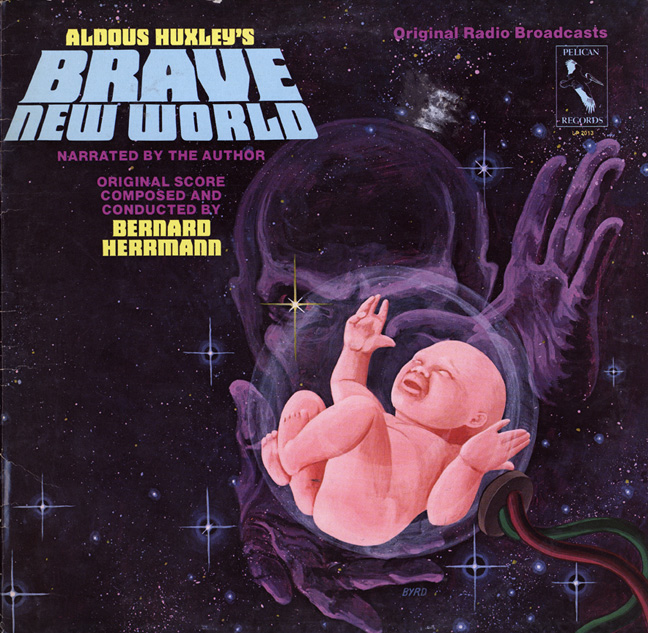
You can listen to Brave New World in its entirety, narrated by Huxley himself, here.


McMillan, Eric . "Point Counter Point." Editor Eric.com. 1 May. 2010. http://www.editoreric.com/greatlit/books/Point.html.

"entry for Brave New World." Wikipedia. 1 May. 2010. http://en.wikipedia.org/wiki/Brave_New_World/.


Saturday, May 1, 2010

Post # 3

Aldous Huxley was a credit to the intelligence of the human species. From birth he was groomed for intellectual superstardom by his academic upbringing; before school age he was learning from his father's botanical laboratory. Working at a technologically advanced chemical plant taught Huxley about the laws of nature and influenced his thoughts about purpose.

Brave New World portends a world in which humans are created (in a process not unsimilar to car production), stimulated by sex and drugs until declining capacity due to age, and killed. The book makes a bleak mockery out of concepts like "convenience" and "the blissful singularity." Huxley implies that humankind actually seeks the dystopian future he has portrayed, further implying that our sense of purpose is way out of whack to ever accept a life of insubstantial complacency.

This comic contrasts Huxley's dystopia with Orwell's.

The Doors of Perception showed how psychedelic drugs supercharged some of Huxley's spiritual insights (he had been philosophically and spiritually Hindu since 1939). He claimed that he felt the personal realization of the Hindu concept of satcitanada, which is a compound word combining existence, consciousness, and bliss. "Duration is replaced by a perpetual present." He talks about the debate of "the way of Martha v. the way of Mary," comparing active and contemplative life, and decides that contemplation should include action. Way trippy.


"Brave New World - Themes and Motifs." Sparknotes.com. 1 May. 2010. http://www.sparknotes.com/lit/bravenew/themes.html.


"entry for Brave New World." Wikipedia. 1 May. 2010. http://en.wikipedia.org/wiki/Brave_New_World/.

Post #2


Huxley was a hugely prolific writer and thinker. He wrote novels, short stories, essays, movie scripts, and poetry, about a wide range of thought provoking subjects, over a career spanning several decades.

He worked for several years at a chemical plant, and later claimed his experience of "an ordered universe in a world of planless incoherence" as influential. Because of his poor eyesight, he was disqualified from service in the first world war and worked as a farmhand at Garsington Manor, where he started a family and wrote his first published novel Crome Yellow, followed by his next novel "Antic Hay." His third novel, Point Counter Point, which he wrote after moving his family to Italy, was much more complex than his previous two novels (which were essentially lighthearted jabs at fashion-oriented society.)

Before moving to California, he lived in Guatemala and El Salvador while he wrote Brave New World, possibly his most popular novel which centers around a theme Huxley had obviously long been interested in but had only briefly explored a few times in his career: the thought that what we should fear most is complete satisfaction. He later wrote to George Orwell, one of his former French students, who had gone on to write 1984. While mostly congratulatory, Huxley wrote that "[w]ithin the next generation I believe that the world's leaders will discover that infant conditioning and narco-hypnosis are more efficient, as instruments of government, than clubs and prisons, and that the lust for power can be just as completely satisfied by suggesting people into loving their servitude as by flogging them and kicking them into obedience."

While in the US, Huxley spent a lot of time ingesting certain chemicals in an intellectual, research-oriented environment. Huxley met many notable members of the early academic psychedelic scene, including occultist Aleister Crowley and "the Johnny Appleseed of LSD" Alfred Hubbard. Huxley recorded his insights in The Doors of Perception and Heaven and Hell.

"Aldous Huxley - Biography." Online-Literature.com. 1 May. 2010. http://www.online-literature.com/aldous_huxley/.

"entry for Brave New World." Wikipedia. 1 May. 2010. http://en.wikipedia.org/wiki/Brave_New_World/.

Thursday, April 29, 2010

Post #1

Aldous Huxley was born just before the turn of the 19th century in Surrey, near London. Several members of his family were academically inclined; his mother and father were a school founder and a schoolmaster (respectively) and two of his brothers were biologists. When he was fourteen, his mother, who was also his teacher at school, died from cancer. from ages seventeen to twenty eye disease deprived him of sight, which returned greatly diminished, disqualifying him from serving in the first world war.

He taught French for a year at Eton college to reimburse his father for his tuition for Balliol. He was recalled as a failure of a teacher but it was noted by one of his pupils, Eric Blair (who would later write under the name George Orwell), that he had impressive language abilities. In his twenties he moved to Garsington, a village near Oxford. Here he married and had a son, who grew up to become an epidemiologist, studying epidemics.


In 1937, a forty year old Aldous moved to Hollywood, where he became focused on spiritualism. Huxley applied for US citizenship, which was continually deferred because of his refusal to literally fight for the US. In his old age he became a huge fan of both eating psychedelic drugs and not wearing his glasses. He even took a weak dose of LSD on his deathbed.


"Aldous Huxley - Biography." Online-Literature.com. 1 May. 2010. http://www.online-literature.com/aldous_huxley/.

"entry for Aldous Huxley." Wikipedia. 1 May. 2010. http://en.wikipedia.org/wiki/Aldous_Huxley.