Hello!

Welcome to Appetite for Distraction at afdhuxley.blogspot.com! This blog will contain posts about the life and work of Aldous Huxley. If you are looking for the Appetite for Distraction music blog, you meant to go here.
Showing posts with label brave new world. Show all posts

Monday, May 3, 2010

Post #4

Huxley's first complex and deeply philosophical novel, Point Counter Point, is structurally formed after the musical style of counterpoint. Where musical counterpoint lays complementary musical ideas on top of one another to form a more complex listening experience, Point Counter Point layers the stories and ideas of many different characters together to develop a chaotic and thought provoking overarching story. Huxley based most of the characters on people he had met or admired; Huxley portrays himself ("Philip Quarles") as a writer who struggles with the overwhelming complexities of everyday life. Recurring devices in the storylines include ineffectual politicians, adultery, soul-crushing ennui.

Brave New World is a dark, futuristic piece of science fiction. A trip to the United States allowed Huxley to glimpse into a future of pleasure and convenience without emotion or substance. In the novel, the citizens of the world state are constantly powerchilling on "soma," a powerful drug which sensually placates the masses, facilitates a religionless society, and often incites orgies. "Everyone belongs to everyone," an idea which in conjunction with the mass production/birth of humans, makes romantic relationships, sexual competition, small nuclear families, and mourning obsolete and often obscene. A small "savage" reservation exists outside of the World State. During the novel, a savage enters the World State and is celebrated for his uniqueness, but he ultimately finds the ideal society shallow.

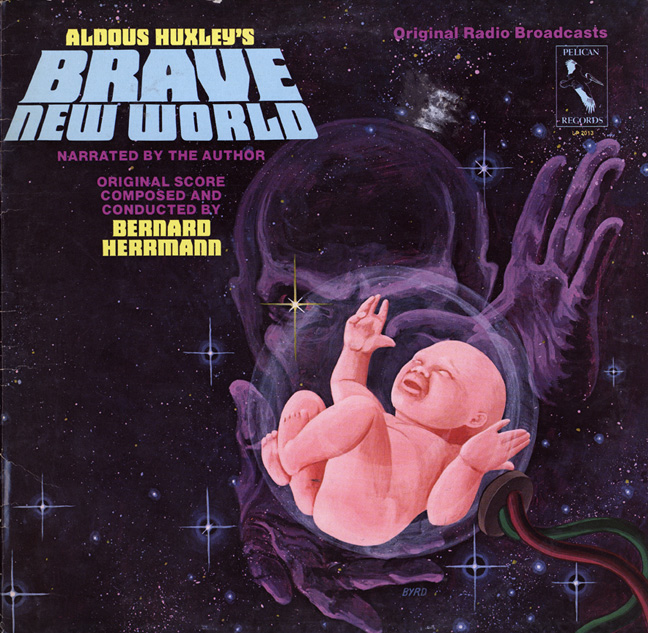
You can listen to Brave New World in its entirety, narrated by Huxley himself, here.


McMillan, Eric . "Point Counter Point." Editor Eric.com. 1 May. 2010. http://www.editoreric.com/greatlit/books/Point.html.

"entry for Brave New World." Wikipedia. 1 May. 2010. http://en.wikipedia.org/wiki/Brave_New_World/.


Saturday, May 1, 2010

Post # 3

Aldous Huxley was a credit to the intelligence of the human species. From birth he was groomed for intellectual superstardom by his academic upbringing; before school age he was learning from his father's botanical laboratory. Working at a technologically advanced chemical plant taught Huxley about the laws of nature and influenced his thoughts about purpose.

Brave New World portends a world in which humans are created (in a process not unsimilar to car production), stimulated by sex and drugs until declining capacity due to age, and killed. The book makes a bleak mockery out of concepts like "convenience" and "the blissful singularity." Huxley implies that humankind actually seeks the dystopian future he has portrayed, further implying that our sense of purpose is way out of whack to ever accept a life of insubstantial complacency.

This comic contrasts Huxley's dystopia with Orwell's.

The Doors of Perception showed how psychedelic drugs supercharged some of Huxley's spiritual insights (he had been philosophically and spiritually Hindu since 1939). He claimed that he felt the personal realization of the Hindu concept of satcitanada, which is a compound word combining existence, consciousness, and bliss. "Duration is replaced by a perpetual present." He talks about the debate of "the way of Martha v. the way of Mary," comparing active and contemplative life, and decides that contemplation should include action. Way trippy.


"Brave New World - Themes and Motifs." Sparknotes.com. 1 May. 2010. http://www.sparknotes.com/lit/bravenew/themes.html.


"entry for Brave New World." Wikipedia. 1 May. 2010. http://en.wikipedia.org/wiki/Brave_New_World/.